PART 2 - DIVING DEEPER INTO BAPTISM
This is the second article in a series put together by the pastoral team to help our church think well about and get the most out of our participation in the sacraments of baptism and communion. These articles are designed to provide a foundational understanding of the two sacraments of the New Testament Church and increase our expectation of the grace we’ll receive through them.
In the first article we defined our terms. We asked the question, “What is a Sacrament?” and we answered it by saying that a sacrament is: 1. A Visible Word, 2. A God-Ordained Activity, 3. A Means of Grace to Us. If you missed this article, you can find it here.
In this second article, having defined what a sacrament is, we turn toward a fuller explanation of all that is signified in the sacrament of baptism. Digging into Scripture in order to increase our understanding of the spiritual realities to which this visible sign points. Asking and answering the questions of how baptism should be practiced. Reflecting on the ways in which the Spirit of God brings to us the soul-altering grace of Christ through this means of grace. And finally, applying our sacramental theology in practical ways that will help us to get the most out of the meaning of this sacrament in the life and worship of our local church.
BAPTISM - OUR DOORWAY INTO THE HOUSE OF GOD
Baptism is the sacrament of spiritual birth in which we participate in the promise of new life in Christ. Through it, we depict our entrance into a new kind of life. As our Sovereign Grace Churches Statement of Faith reads:
Baptism is an initiatory, unrepeated sacrament for those who come to faith in Christ that pictures their remission of sins and union with Christ in death and resurrection. Through immersion in water in the name of the Father, Son, and Holy Spirit, the believer publicly proclaims his faith in Christ and signifies his entrance into the body of Christ (We Believe: A Statement of Faith section 12, paragraph 3).
In this article, we’ll consider three aspects of the new life in Christ that we participate in via the sacrament of baptism: a pledge of new loyalty, a public entrance into a new people, and a true spiritual participation in the death and resurrection of Jesus Christ. As we die to old loyalties, old identities, and to the sin that enslaved our old man, we pass into new creation life via the sacrament of baptism.
BUT FIRST, LET’S DEFINE OUR TERMS
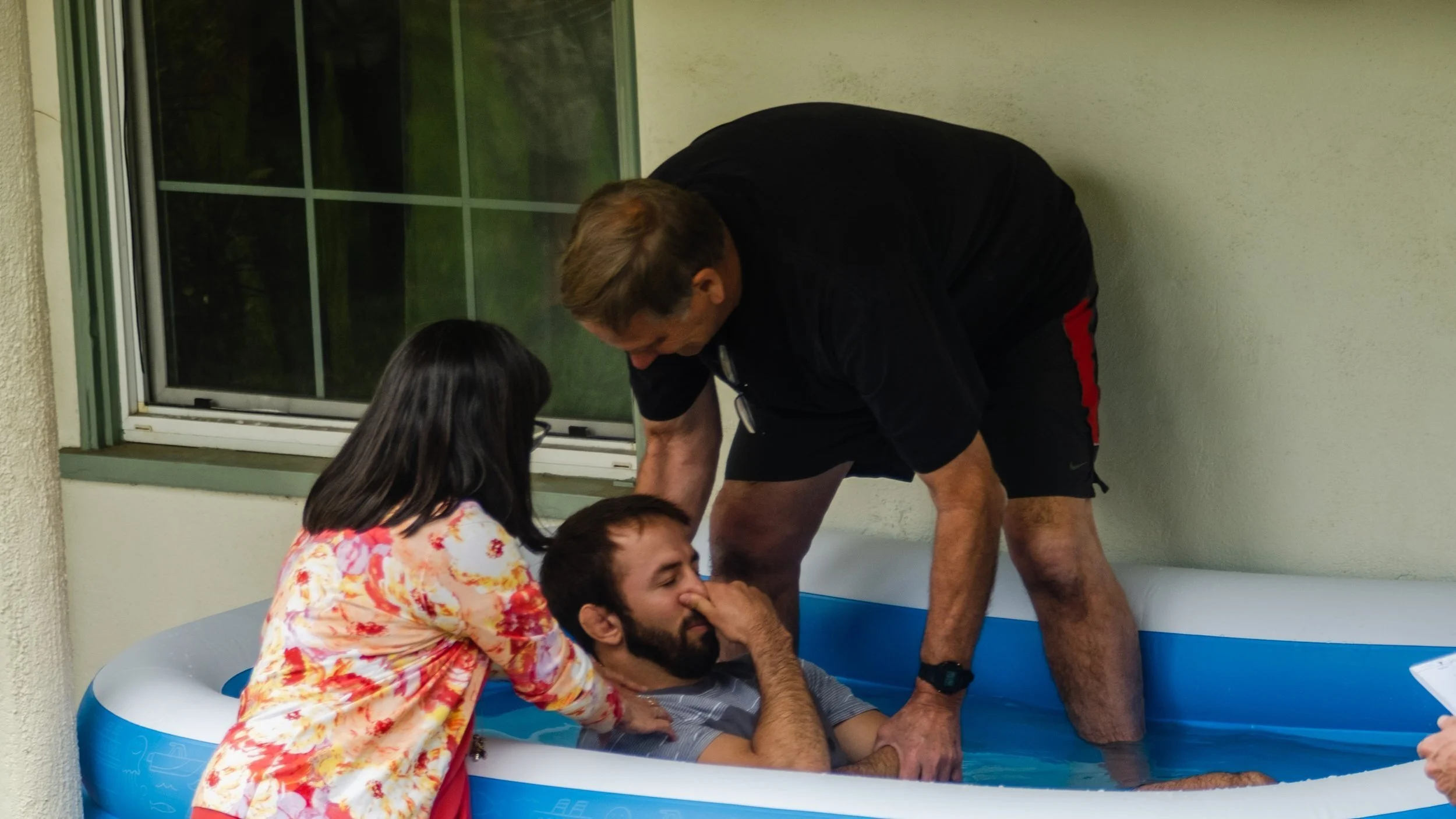
The term baptism comes from the Greek baptisma/baptismos which are the noun forms of the verb, baptizo. The verb indicates the immersing of its object into water. Such that, baptism means immersion into water. This meaning of the term, in addition to what is being signified in Christian baptism is instructive as we consider how we baptize. Do we sprinkle water upon the recipient of baptism? Pour some over the head of the one being baptized? Or do we fully immerse them in the water just as the meaning of the term would suggest? We practice full immersion because: 1. that is what the term means, 2. this mode of baptism best captures the spiritual reality the sign signifies, and 3. because it is was the experience of Jesus himself.
In the New Testament, we read of Christ himself undergoing baptism in the Jordan River (Mt 3:13; Mk 1:9-11; Lk 3:21-22). Though he was the sinless God-man, he received John the Baptist’s “baptism of repentance” in order to identify with the sinful people he came to save. In the life of Jesus, we see him doing what Israel should have done. Demonstrating their repentance to God via baptism to prepare themselves for the Messiah (Mt 3:14-15). Passing the test in the wilderness and not giving into the devil’s temptations, as wilderness generation did on their journey to the Promised Land (Mt 4:1-11). Keeping the Law of God perfectly (Mt 5:17). Never failing to love God with all their heart, soul, and strength or their neighbor as themselves (Mt 22:34-40). Jesus was the true Israel, who succeeded everywhere they had failed.
Additionally, the baptism of Christ that marked the beginning of his earthly ministry, was also intended to foreshadow the ultimate goal of that ministry: his death and resurrection. Just as Christ was emerged under the waters of baptism, he would be crucified and buried in the tomb. But, just as “he came up out of the water,” he would be raised from the dead never to die again (Mk 1:10). Jesus himself makes this connection in the Gospels as he speaks of the suffering that awaits him in Jerusalem as a “baptism.”
In Mark 10:32-34, Jesus foretells is death and resurrection for the third time to his disciples as they are on the cusp of arriving in Jerusalem. After this, James and John request places of honor in Christ’s Kingdom – presuming that he’ll commence his reign when they arrive in Jerusalem. They are correct that Christ will inaugurate his Kingdom there, but they haven’t quite grasped how. In reply, Christ asks them if they are willing to do what it takes in order to reign with him? And what is that? It is “to drink the cup,” that he drinks, “to be baptized with baptism with which” he is baptized, and quite literally, to give their lives in death (Mk 10:38-45). Christ would be crowned with resurrection glory after giving “his life as a ransom for many” to redeem God’s people (Mk 10:45).
His baptism would demonstrate the reality of new creation life through death. Both as he died and was raised to everlasting life and as his death and resurrection would secure for us the promise of new life. Because of this, our baptisms, too, dramatically depict the reality of new life through death. Passing through the waters of God’s wrath and judgment for sin and rising up to demonstrate that we have been set free from all condemnation.
In summary here, Christ was baptized at the outset of his ministry to identify with the people he’d redeem. At the climax of his ministry, he accomplished their redemption through his death and resurrection. And, at the end of his earthly ministry, Christ commands that all his redeemed identify with him through baptism (Mt 28:19-20). And it’s to this identification that we now turn.
BAPTISM IS A PLEDGE & PROFESSION
In our baptism, we are publicly declaring our allegiance to the Christ who was demonstrated to be the Messiah and Lord of all via his resurrection from the dead. Baptism is our public declaration of our allegiance to Christ. As we participate in the sacrament, we signal to the watching world that our life is no longer our own but belongs to Christ. We publicly acknowledge that Jesus Christ as the Lord of our lives and that we are willing to leave life as we knew it behind to follow him.
We remember that the word sacramentum, from which we derive, “sacrament” was “originally a military term describing the oath of allegiance and obedience that a soldier solemnly pledged to his commander” (Christ, Baptism, And The Lord’s Supper, Leonard Vander Zee). And that following this common usage, the early Christians of the second century, utilized the to describe “the pledge of faith and allegiance made by candidates for baptism to their Lord” (Vander Zee).
In our baptism, we are pledging allegiance to King Jesus and declaring to all the world that we have turned away from a life of self-serving sin to a new life of service and loyalty to Christ.
Acts 2:37-41 provides the paradigmatic framework for New Testament baptism. On the day of Pentecost, the Apostle Peter preached a Spirit-empowered sermon in which he declared that Jesus of Nazareth who had just been rejected and crucified had actually been raised from the dead and was the long-awaited Messianic deliverer of God’s people. And not only this, but the crowds gathered for the feast of Pentecost contained the very same individuals who had rejected Christ and called for his crucifixion just 50 days earlier.
Peter proclaimed the good news that Christ was the Messianic deliverer as well as the bad news that those who heard him were complicit in rejecting his lordship over their lives. Through his preaching, the Holy Spirit brings conviction of this sin to his hearers and they are “cut to the heart” (Acts 2:37). Recognizing their rebellion to the Lord, they ask Peter what they should do. He replies, “Repent and be baptized every one of you in the name of Jesus Christ for the forgiveness of you sins, and you will receive the gift of the Holy Spirit…So those who received his word were baptized (Acts 2:38, 41).
He told them: 1. to repent of the sin of rejecting Christ as Lord and, 2. to acknowledge Christ as Lord through baptism. In this way, they’d publicly declare that the one they’d rejected was now the one who ruled over them. They would turn from the old life they were living in which they didn’t acknowledge Christ’s reign, to a new way of living in which every aspect of life would be submitted to his rule.
Just like them, as we make this pledge of loyalty to the crucified and risen Christ, we’re simultaneously professing our faith in all that his death and resurrection accomplished for us. In our baptism, we publicly indicate that we are following Jesus in a new way of living because we believe he has truly given us a new life. We testify that we have laid hold of Christ and his promises by faith and have become new creations in him.
As 1 Peter 3:21 says, “Baptism…now saves you, not as a removal of dirt from the body but as an appeal to God for a good conscience, through the resurrection of Christ.” Now this doesn’t mean that baptism in and of itself has saving power, but that, as Thomas Schreiner says:
“Believers at baptism ask God – on the basis of the death and resurrection of Christ – to cleanse their conscience and forgive their sin…Believers at baptism can be confident on the basis of the work of the crucified and risen Lord that their appeal to have a good conscience [in effect, to be pronounced right with God] will be answered” (1, 2 Peter, Jude).
In other words, in our baptism we sacramentally lay our claim upon the saving promises of the gospel. In this way, baptism now saves us. As we are baptized upon our confession of faith, we are sacramentally making our appeal to God to grant the promise of new life, accept us as his own, and allow us entrance into his Kingdom and people. In baptism, as we confess our faith in Christ, share our testimony, and are immersed in water, we are professing that the promise of new life is ours on the basis of the death and resurrection of Christ for us.
Baptism marks the beginning of a new life lived under a new Lord. And even more than that, it marks the beginning of a new life lived among a new people.
BAPTISM IS OUR PUBLIC ENTRANCE INTO THE PEOPLE OF GOD
Baptism is our “visible initiation into the kingdom of Christ…[our] integration into the local gathered kingdom of saints” (The Mystery of Christ: His Covenant & His Kingdom, Samuel Renihan). Through baptism, we are added to people of God as the gathered church witnesses and participates in our sacramental entrance into the body of Christ.
Picking back up with Acts 2, we read of the 3,000 new believers on the day of Pentecost: “So those who received his word were baptized and there were added that day about three thousand souls” (Acts 2:41). They believed the gospel, were baptized, and subsequently “added” to the church.
In Acts, hearing the gospel, believing the gospel, being baptized, and joining the church all go hand in hand. So, even as we might read of other conversion accounts in Acts where Luke says people were “saved” or “added” but not baptized, we should infer they were baptized. The biblical model presented here is that baptism was the first step in joining the local church.
As a church, when we witness a baptism take place, we hear the testimony of the baptized and behold the sacramental depiction of their new life with Christ as they are immersed in and raised up out of the water. All this testifies to the reality that this man or woman being baptized has been born again of God and entered into his family. They have become an adopted child of God through their faith in the Son of God and as such, they’ve become a part of our family too. As God ushers them into newness of life, he ushers them into a new people, created by the gospel.
As a means of grace, the Spirit of God works through baptism to incorporate us into the body of Christ. As Paul writes in 1 Cor 12:12-13, “For just as the body is one and has many members, and all the members of the body, though many, are one body, so it is with Christ. For in one Spirit we were all baptized into one body – Jews or Greeks, slaves or free – and all were made to drink of one Spirit.” What’s the connection between this Spirit baptism and our water baptism? The latter is a sign and seal of the reality of the former.
By the Spirit of God working upon our hearts we have come to confess Jesus as Lord and put our faith in him (1 Cor 12:3). He has caused us to be inwardly and invisibly born again. He has brought us into spiritual union and communion with Christ. So too, by the same Spirit that brought us into communion with Christ, have we been brought into communion with each other, the “body” of Christ. This spiritual renewal and unity with Christ and each other are accomplished through the Spirit baptism Paul refers to above.
This being the case, our water baptism becomes a sign and seal of this reality: that we’ve truly been added into the body of Christ along with all others who have believed in him (1 Cor 12:12-13). As water baptism adds us to the visible church, it also signifies that we’ve been spiritually added to the invisible and universal church (the communion of all true believers for all time) through the work of the Holy Spirit. Moreover, as the Spirit has sealed us in Christ (2 Cor 1:22; Eph 1:13) and “bears witness with our spirit that we are children of God” (Rom 8:16), water baptism sets a further seal upon our hearts that our belonging to Christ is as real as the water in which we were immersed. The grace of water baptism is to set a seal upon our minds, hearts, and consciences of all that is true because of our Spirit baptism. The Spirit works through water baptism in order to signify and deepen our experience of what we’ve undergone in Spirit baptism. As such, these two realities are really two sides of the same coin. One being the sacramental extension and completion of the spiritual reality began by the other.
So far, we’ve seen that baptism is the public means of expressing one’s faith and joining the church. Yet, underlying this outward expression and identification, there is a crucial inward reality. In baptism, believers are added to the church, or body, of Jesus Christ, because in baptism we signify our union with Christ himself. Truly, we are joined to the church because we have been joined to Christ, the head of the body and Lord of the Church. And as we’ve been joined to Christ, we’ve been joined with Christ in his death and resurrection.
BAPTISM IS OUR PARTICIPATION IN THE DEATH & RESURRECTION OF CHRIST
Baptism sacramentally unites us to Christ. It is a sign of our union with Christ through faith and a means of grace by which we participate in his death and resurrection. As we’ve earlier stated that baptism is our participation in the promise of new life in Christ, the Bible teaches that our participation in his death and resurrection is the means by which we come into all that is promised. In other words, this participation with Christ explains how we come into new life in Christ. We pass into new creation life through death. Consider Paul’s words in Romans 6:1-4:
“What shall we say then? Are we to continue in sin that grace may abound? By no means! How can we who died to sin still live in it? Do you not know that all of us who have been baptized into Christ Jesus were baptized into his death? We were buried therefore with him by baptism into death, in order that, just as Christ was raised from the dead by the glory of the Father, we too might walk in newness of life.”
Paul is fielding an anticipated objection to his gospel of grace (see Rom 5:20-21). And, in response to the question, “If grace abounds all the more when sin abounds, why not just go on sinning?” he answers, “Haven’t you been baptized?!”
His response to the Christian who would carry on sinning is to ask them to consider their baptism. He does so because in baptism we physically, visibly, and sacramentally signify that we have been spiritually, invisibly, and truly united with Christ by faith. And what we’ve been united in by faith is nothing less than the death and resurrection of Jesus Christ. So, the basic thrust of his response is, “How can you go on sinning like nothing has even happened? How could you undergo this death and resurrection and somehow live the same kind of life?”
The Bible teaches us that the Holy Spirit has united us to Christ by faith and that, in this unity, we have truly and really participated in the death and resurrection of Jesus. So that when he died on the cross, we died with him. When he was raised from the grave, we were raised with him. As we died with him, we died to our sin and God satisfied his justice toward us in Christ. As we were raised with him, we received the new life he inherited as a reward for his perfect obedience to God.
In baptism, we unite with these realities in a special way as the same Spirit who united us to Christ works in our souls to set a seal upon the remission of our sins and our new status of righteousness in Christ. Our baptism confirms that we are no longer condemned sinners under wrath, but justified saints under grace. So that for Paul to say, “Have you not been baptized?” is the same thing as for him to say, “Have you not come into a new identity in Christ?”
In this way, baptism is the sacramental turning point of our entire lives. We can’t go on sinning, because in light of our baptism, “We know that our old self was crucified with him…so that we would no longer be enslaved to sin” (Rom 6:6). Just as “the death [Christ] died to sin, once for all,” so too have we died to sin, “once for all” (Rom 6:10). Not that baptism makes us perfect or takes away our experience of the on-going struggle against sin, but that baptism marked the decisive moment in which our lives were no longer ruled and dominated by sin.
As Leonard Vander Zee says, “As Jesus’ burial was the last step of his dying…so our burial in baptism is the true mark of our absolute death to the old life of sin and death.” Because of this, Paul is saying, “How can you go on living in sin if you’ve already died to sin?!” How could we return to the very sin from which Christ has set us free (Rom 6:7)! You can’t live like you used to, because that person is dead. Christ has made you into something else now, and that new creation has no part in living like the old man. Baptism is the headstone that marks the grave of our old life and self.
But that’s not all! Not only is baptism the “true mark of our absolute death” it is also the “true mark” of our new and everlasting life! For, as Paul writes, “if we have been united with him in a death like his, we shall certainly be united with him in a resurrection like his” (Rom 6:5). If we’ve participated in Christ’s death, then we’ll just as much participate in his resurrection life. Christ died to sin once for all upon the cross, “but the life he lives [now and forever] he lives to God” (Rom 6:10). Just as Christ now lives to God, so do we! We who were once dead in sin now, “must consider [ourselves] dead to sin and alive to God in Christ Jesus.” (Rom 6:11).
We can look backward to our baptism to be assured that we truly have passed from death to life. That the new life we’ve laid hold of by faith is as sure as Christ was raised from the grave and as sure as we were raised up out of the water. The Spirit-wrought grace of baptism is to seal our hearts and spirits with the confidence that we’ve received new life in Christ.
And out of this confidence we can live as new creations, boldly, freely, and joyfully serving Christ. We can look forward to the future and expect that no matter what befalls us, we are Christ’s and that wherever life may take us it will end in eternal resurrection life.
APPLICATIONS OF OUR BAPTISMAL THEOLOGY
1. Get baptized! If you’ve never been baptized as an expression of your faith in Christ, we encourage you to be baptized if you have believed in him, experienced new life in him, and have been united to him by faith. Signify that in baptism.
We encourage you to get baptized if:
a. You believe in Christ but have not been baptized. Don’t delay in obeying Christ and experiencing his grace through this sacrament!
In the New Testament, baptism went hand and hand with conversion. We don’t read of any unbaptized believers present and participating in the earliest churches for any extended length of time. And even if there were, this would certainly be the exception not the norm. What we do see is that the 3,000 who believed on the day of Pentecost were baptized that same day (Acts 2:37-41). The Philippian jailer was baptized that same night - even in the middle of the night - having been awakened from his sleep by the earthquake that got his attention to receive the gospel (Acts 16:25-34)! The Ethiopian Eunuch demanded his chariot pull over on the desert road as soon as he’d understood and believed the gospel so that Philip could baptize him right then and there (Acts 8:36-38). In the New Testament, there is a proper urgency to baptize new believers.
Why this urgency? Because baptism was and is the first visible step of the Christian life. After the Spirit works in our hearts through the gospel message and we come to faith, we are thereby united to Christ. We come to possess him and all the benefits of his redemptive work as our faith connects us to him. That invisible union being the case, the very next thing to do is express this inward reality outwardly through baptism. As soon as we’ve received the spirit of adoption internally (Rom 8:14-16; Gal 4:6), we are called to demonstrate our entry into God’s household externally through baptism.
b. You were baptized as an infant or young child apart from your own profession of faith in Christ. Baptism is a sacramental expression of our faith-union with Christ, and apart from faith, we are not united to Christ. Simply put, without faith in Christ there is no union with Christ. And without this union, we rob the sacramental sign of the spiritual reality it signifies if we apply it to those without a faith of their own.
c. You were baptized in a church or context in which the gospel – what Christ accomplished in his death and resurrection – was not clearly proclaimed or even affirmed. Christian baptism must be just that, Christian. And to any who may have been baptized in a church that did not practice or proclaim orthodox Christianity (but was instead a cult or heretical sect), we’d encourage you to be baptized for the first time in a biblical manner in a church that faithfully proclaims the word and properly administers the sacraments.
If you’re reading this and asking, “How can I be sure I’m ready to be baptized?” consider the diagnostic questions below. Candidates for baptism should be able to:
1. Communicate an understanding of the gospel.
2. Express faith in Jesus Christ for salvation.
3. Evidence godly sorrow over sin and the intention to repent of their sin.
These items should be present in any candidates for baptism, but they don’t need to be perfectly present in order to qualify for baptism. We're saved by grace through faith in the work of Christ alone. Baptism is not a work we do but an extension of Christ’s work in us as we respond to him with faith and obedience. We’re always going to be growing in our knowledge of the gospel (2 Pet 3:18). Our faith will never be immune to wavering. And even as we truly forsake and repent of sin, we’re always going to be engaged in the battle against it (Gal 5:16-17). None of this would disqualify someone from receiving baptism. The question isn’t are the above items “perfect,” but are they, by God’s grace, “present?”
Contact a pastor here to inquire about baptism at Cross of Grace Santa Ana.
2. Remember your baptism. Remember your past baptism with Christ in order to be spurred on to present obedience to Christ. Just as Paul appealed to the Romans in Rom 6:1-11.
3. Don’t get re-baptized IF… Don’t get re-baptized if you feel your first baptism did not coincide with enough gospel knowledge or subsequent spiritual fruit. Re-baptism here refers to an additional baptism after you participated in a valid baptism in which: the gospel was proclaimed, you were baptized in the name of the Father, Son, and Holy Spirit, and you had professed your faith in Christ. If you believed with even mustard seed faith, then your baptism was a valid expression of your true union with Christ. Why? Because though our faith is important – it is the instrument that connects us to Christ and the means by which we received the Spirit-wrought grace of baptism – the strength of that faith is less important than the strength of the Savior in whom we’ve believed. Even the tiniest mustard seed faith connects us to the Christ who will hold us fast and allow nothing and no one (not even ourselves!) to snatch us out of his hand (Jn 10:27-30; Rom 8:35-39; 1 Thess 5:23-24; 1 Pet 1:3-5; Jude 24).
Take heart and be encouraged as your shallow understanding of baptism deepens over time (pun intended). Though you did not understand it all in the moment, as your knowledge grows, so will your appreciation for all your baptism meant. Beyond just this, your deepening appreciation of baptism will also coincide with a greater celebration of baptisms as you witness them in the context of the local church.
We thank Christ for the sacrament of baptism: our doorway into the house of God!