Dwelling with God Again
THE TABERNACLE AS A NEW KIND OF EDEN
Exodus 25-31 is the instruction manual for building God’s house amongst the people of Israel. Within these chapters we see that the structure of the house itself as well as the things within it say a lot about the kind of life inside. And one of the most important things the tabernacle design is meant to do is make us think of Eden.
Eden: the garden of God where he first dwelled with man (Gen 2:8). The place where our story began. That place we’re longing to return. A sense of this place is what God is after in the sanctuary he commanded Israel to build. This is what he’s got in mind when he reveals “the pattern of the tabernacle” to them (Ex 25:9). A place reminiscent of Eden.
We’ll see this theme develop and come full circle as we take our tour of the tabernacle. Moving from the interior to the exterior of the house. From the heart of the home to the front porch entrance. Beginning in the most special room with our focus upon the most important piece of furniture God commanded Israel to make: the Ark of the Covenant.
THE ARK OF THE COVENANT - EX 25:10-22
The Ark of the Covenant was the most holy thing inside the house. The place where heaven met earth. And what it was was a golden box, carried by poles, which would come to contain the tablets of the 10 Commandments. It was covered by a lid known as the “mercy seat” that was topped with two cherubim "overshadowing" the ark with outstretched wings. From here God says in 25:22, “I will meet with you, and from above the mercy seat, from between the two cherubim that are on the ark of the testimony, I will speak with you about all that I will give you in commandment for the people of Israel.” The ark at the center of the Most Holy Place is a picture of God’s own throneroom in heaven. The place from which he rules and speaks and judges the earth. Surrounded by angels who praise him night and day. Dwelling in the splendor of his majesty. And here, through the tabernacle, that ark becomes the footstool - as it were - of God’s throne upon the earth. Representing that the God of heaven reigns and advances his kingdom upon the earth in and through his people. Reminding us of how God once spoke and walked and lived among Adam and Eve and called them to spread his kingdom and take dominion over the earth (Gen 1:28-31). The ark shows us that homecoming only happens through acknowledging that God is the Lord and we are not.
THE TABLE OF SHOWBREAD - EX 25:23-30
Next, we move out of the innermost room, into what’s known as the Holy Place. A chamber separated by a curtain, which contained a golden table, lampstand, and altar for incense. The table is known as the table of showbread. Upon which 25:30 says, “you shall set the bread of the Presence on the table before me regularly.” This table would be filled with a constant supply of fresh bread. Representing God’s own presence with his people. To give and sustain their lives - just as bread nourishes the body. Even more, this table would always be ready for a meal. Stocked with bread and surrounded by plates and dishes. Which meant that in the tabernacle, God hadn’t just drawn near to speak and command the people, but to sit and commune with them as well. This sweet fellowship is an echo of Eden.
THE GOLDEN LAMPSTAND - EX 25:31-40, 27:20-21
And that echo grows louder as we turn our gaze to the golden lampstand. A menorah or candlestick that was covered with 7 lamps that would remain lit. Ex 27:21 says that “morning and evening” the oil for burning would be replenished so that the fire would never die. And in that dark interior of the tent, that seven-branched candelabra would look like a shining tree of life and light. Here is Eden again: “And out of the ground the Lord God made to spring up every tree that is pleasant to the sight and good for food. The tree of life was in the midst of the garden” (Gen 2:9). Here is God with his people, the light of his face upon them. Shining - even now, on the other side of the fall into sin - into the darkest parts of their lives and ours.
THE ALTAR OF INCENSE - EX 30:1-10, 34-38
Along with the burning light, there was the burning altar of incense. Located in front of the curtain or veil that separated the Holy Place from the Most Holy Place, this golden altar would continuously emit smoke to appropriately veil God’s glory from being too directly seen as well as cover the smell of all the bloody sacrifices taking place outside the tent. It represented the prayers and intercessions of God’s people always rising - and what’s more - always being received by God. It shows that in addition to being a King who rules and Creator who sustains, God is a loving Father who hears our prayers.
THE TENT ITSELF - EX 26
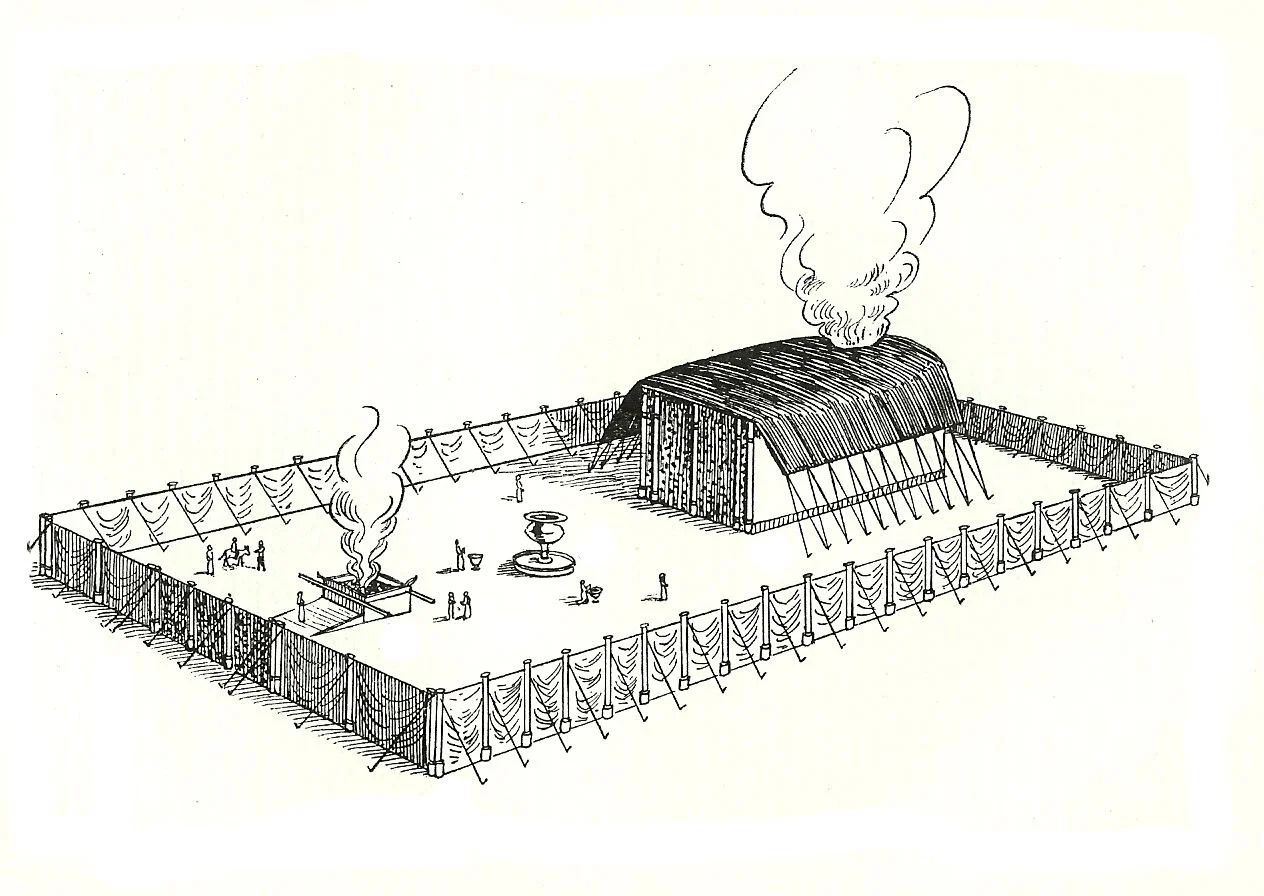
A Father who welcomes us into his own house and adopts former exiles from Eden, rebels to his reigns, and strangers to his presence into his own family. So let’s talk about the house itself. Which, in the preview and taste of what’s to come that is the tabernacle, took the form of a large, elaborate tent. In Ex 26 we read about this representation of God’s royal residence. The interior walls of the structure lined with curtains of “fine twined linen and blue and purple and scarlet yarns” with "cherubim skillfully worked into them” (26:1). Royal colors of blue, purple, and scarlet. Cherubim, the throne guardians of God - who were present in the garden, and even served as angelic bouncers with a flaming sword after man’s fall into sin - lining the walls. This tent is a new sort of Eden composed of two separate rooms, the Holy of Holies, or Most Holy Place, and the Holy Place, where God would meet with his people.
THE BRONZE ALTAR AND BASIN & THE OUTER COURTS - EX 27:1-19, 30:17-21
But, we know those people were not a holy people, so how would they get in? They would begin by entering the outer courts. This courtyard was visible to all, cordoned off by linen curtains so that no one can casually stroll into sacred space, and guarded by a gate of royal colors. Upon entry, further progress could only come through the cleansing of sin and blood of sacrifice. On behalf of the sinful people, the appointed priests would make atonement upon the altar of bronze, and then wash in the waters of the basin before entering into the holy presence of God. In this way, the tabernacle was a living illustration of the truth that no one can come to God unless the penalty for sin is paid and the corruption of sin is washed away. The shedding of blood and the passing through water point the way to the once-for-all shedding of the blood of Christ and our Christian baptism which marks the beginning of our entrance into that which is truly life.
GOD’S DESIGN TO DWELL WITH US IN CHRIST
More than anything, the biggest takeaway of this ancient tent is God’s design to dwell with us in Christ. That we can’t come “home” unless he takes us. That we’ll never find rest until we rest in him! Because, Jesus is the true tabernacle. As Jn 1:14 says, “The Word became flesh and dwelt among us.” And in the Greek that word “dwelt,” literally means, “he pitched his tent among us.” That he tabernacled amongst us! Fulfilling all that was bound up in the design of God’s portable palace and temporary house. And even more, as the story of Scripture advanced and the permanent structure of the temple was built in Jerusalem, when the living breathing tabernacle that is Jesus walked the earth he said, “something greater than the temple is here” (Mt 12:6). All of which means that Jesus Christ himself is God dwelling with man. Fully God, fully man come together in one person. So that the only way to come to God again is to come through him. To receive his sacrifice of blood upon the altar of the cross, to pass through the waters of baptism, and come into the “home” you’ve always longed for through faith in him.
He and he alone can bring us back to God today. He and he alone can bring us to that great day when God brings heaven all the way down to earth (Rev 21:1-2). Where we enter into the place he’s gone to prepare for us. Gathering around the Lamb who was offered upon the altar of the cross but now lives. Who is himself “the lamp” who gives light to the new creation (Rev 21:23). Who welcomes us to drink from “the river of the water of life” and eat from “the tree of life” at the center of his city (Rev 22:1-3). Who will be “seated on the throne” the ark represented - reigning in our midst (Rev 21:6, 22:5). As we fall down at his feet and offer our praise like incense that rises forever.
Lord, make us ready for that day we come all the way home!